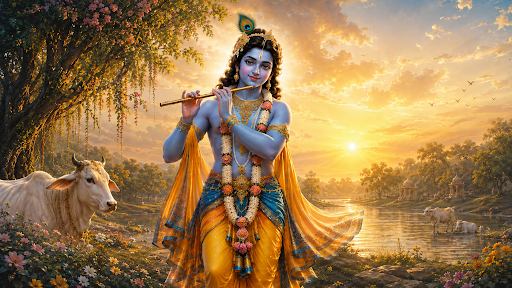
Krishna Playing with the Gopas on the Banks of Yamuna Maa

In Hindu tradition, the word Leela transcends the concept of ordinary actions; it translates to divine play or cosmic sport. Unlike human actions driven by karma, desire, or necessity, the actions of the Supreme Deity, particularly in His avatar as Krishna, are performed purely out of spontaneous joy and love.
Krishna’s childhood (Bal Leela) spent in the pastoral village of Vrindavan is arguably the most cherished phase of His pastimes. Here, the Almighty does not present Himself as an awe-inspiring, distant ruler of the universe. Instead, He manifests as a sweet, accessible, and mischievous cowherd boy (gopa). By stripping away the grand barriers of majesty, Krishna allows the residents of Vrindavan to love Him unconditionally as an intimate companion.
The Sacred Yamuna River: More Than Just Water
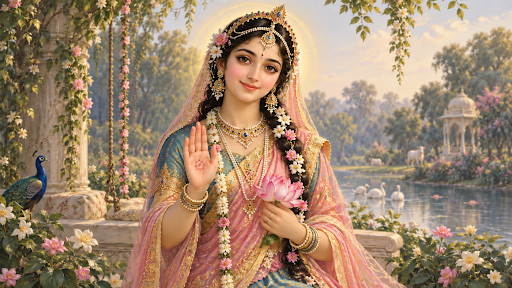
The backdrop of this divine play is the Yamuna River. In the context of Krishna Leela, the Yamuna is not merely a geographic feature; she is a sentient, living deity who is deeply in love with Krishna. The Puranas describe how the Yamuna would slow her currents, create gentle whirlpools, and bloom with lotuses just to touch His feet.
The banks of the Yamuna served as the perfect theater for these childhood antics:
- The Pasturelands: Where thousands of calves grazed peacefully under the watchful eyes of the young boys.
- The Cool Waters: Providing a refreshing escape from the tropical afternoon heat of Braj.
- The Shady Groves: Where the sakas shared their lunches, laughing and playing pranks on one another.
Sharing the Remnants of Devotion
The sakas, including close companions like Sridama, Subala, Dhansukh, Mansukh, and Madhumangala, represent the pinnacle of Sakhya Rasa, the spiritual mood of friendship.
When the midday sun grew warm over Vraja, the boys would drive their calves into the shade and rush toward the cool currents of the Yamuna to splash and swim. Afterward, they would sit in a tight circle on the soft sand to open the lunch tiffins packed by their mothers. Rather than a structured, polite meal, it was a scene of joyful, uninhibited sharing.

Sri Krishna, driven entirely by a deep hunger for the love of His companions, would constantly peek into His friends' food, eagerly asking what special dishes their mothers had prepared and begging for a taste.His friends would laughingly tease Him, telling Him to focus on His own lunch instead of constantly eyeing theirs.
But the Lord's joy lay entirely in tasting their food. When a friend tried to pop a handful of lunch into his own mouth, Krishna would playfully catch his hand, taking the half-eaten food straight from his lips. He would joyfully praise the meal, saying how incredibly delicious it was and joking that Mother Yashoda needed to get the recipe. The Lord of the universe was completely captured, not by the food itself, but by the raw, affectionate remnants of His devotees.
The Supreme Lord Becomes a Horse for His Friends
Refreshed by their lunch, the boys would leap back onto the sandy shores to play wrestling matches, blindman's buff, and running races through the groves. In these games, all boundaries of majesty completely vanished. There was no special treatment just because He was the prince of Vraja.
The boys had a strict rule for their games: whoever won would get to ride on the back of the loser. Whenever Sri Krishna lost a race or a wrestling match, His friends held Him strictly to the rules.

Sridama or Dhansukh would climb onto His shoulders, and the Supreme Lord—whom great Vedic mantras praise—would drop down on all fours, willingly becoming a horse for His friends. In the thrill of the game, the rider would use his heels to gently nudge Krishna's sides to make Him gallop faster across the sand. Tears of pure ecstasy would well up in Krishna’s eyes. He would run swiftly, then purposely slow down just to receive another affectionate nudge from His friend. Through the power of Yogamaya, both God and the devotee forgot the distance between them, bound only by the singular, overwhelming sentiment: "He is mine."
Spiritual Reflection
This beautiful pastime shifts our entire understanding of how to approach the Divine. Often, we assume that connecting with God requires complex rituals, immense scriptural knowledge, or an unblemished social status. We approach Him with rigid formality, driven by a sense of distance or fear.
The play of Krishna with the sakas reveals a profound truth: the Supreme Lord is completely indifferent to external majesty. He doesn't care about what we own or how high our status is in the material world. The only thing that can bind the master of the universe is simple, unadulterated, and unalloyed love.
The sakas didn't see Krishna as the Almighty God. They saw Him simply as theirs. This is the heart of Sakhya Bhav. It reminds us that our ultimate spiritual goal isn't to perfect the mechanics of worship, but to soften our hearts until all formal distance vanishes. God doesn't look for grandeur. He looks for a clean, sincere heart that can look toward Him in complete solitude and effortlessly think, "He belongs to me, and I belong to Him."
#YamunaMaa #KrishnaLeela #SpiritualReflection #Braj