Everyone has vastly different life experiences, and when we truly reflect on it, the sheer uniqueness of each individual's journey is profound. As we navigate our own distinct paths, we frequently encounter challenging situations. Due to a lack of awareness in mind management, we naturally look for comfort and adopt coping mechanisms that may not be healthy. For instance, someone feeling emotionally low or stressed might reach for a tub of ice cream seeking solace. While this provides temporary relief, repeating this response whenever sadness strikes turns it into an ingrained habit that is difficult to break. Beyond overeating, people often rely on various other emotional crutches such as doomscrolling on social media, excessive daydreaming, or impulse shopping, to numb uncomfortable feelings. Over time, when we realize these crutches are doing more harm than good, we try to quit, only to stumble or relapse. Other factors like burnout and peer pressure further complicate this cycle. But how do we break free and resolve this?
The Restless Mind: Arjun’s Question, Krishna’s Answer
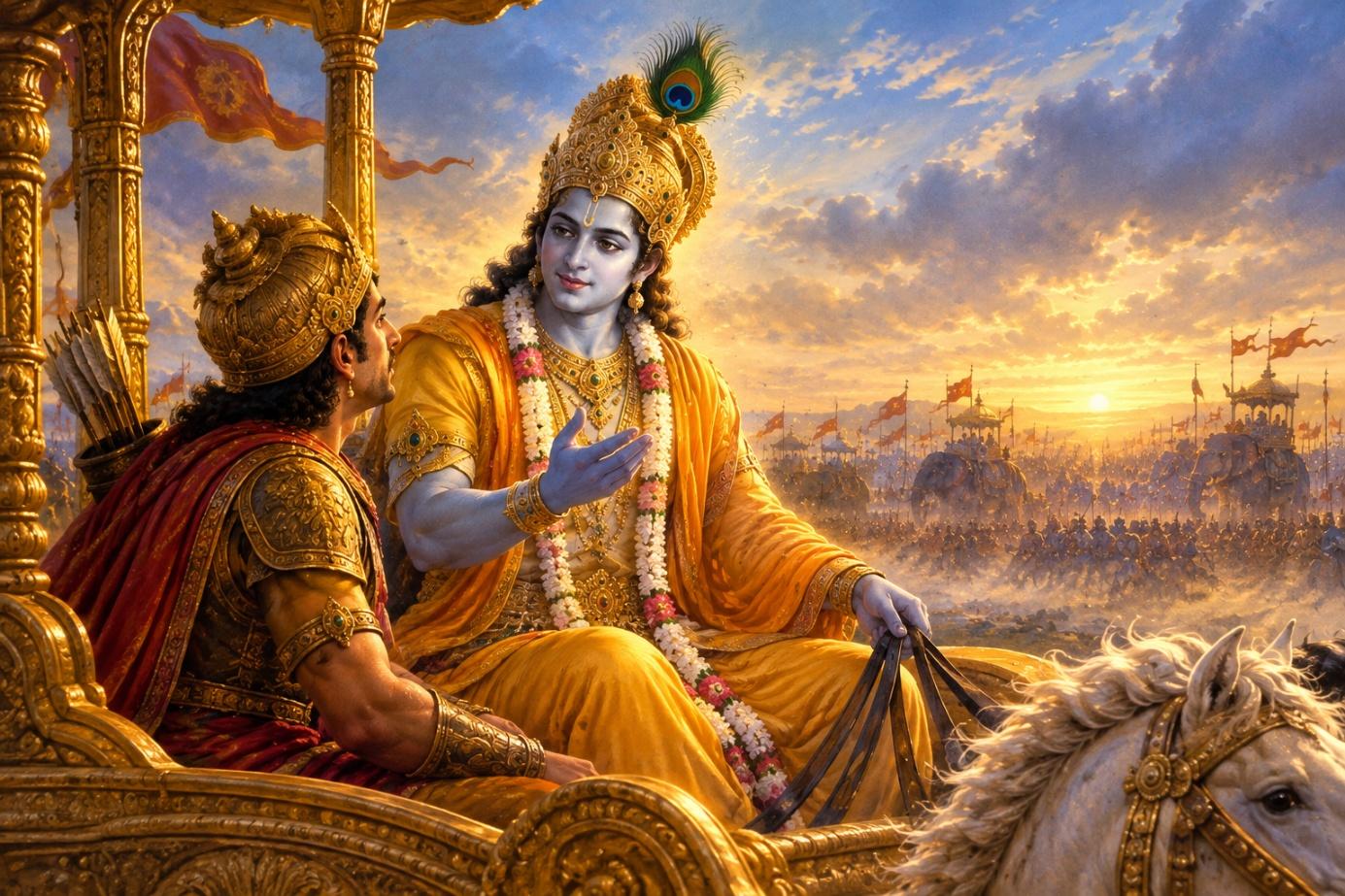
Arjun asks Shree Krishna in Bhagavad Gita (Verse 6.34):
“chañchalaṁ hi manaḥ kṛiṣhṇa pramāthi balavad dṛiḍham
tasyāhaṁ nigrahaṁ manye vāyor iva su-duṣhkaram”Translation: The mind is very restless, turbulent, strong and obstinate, O Krishna. It appears to me that it is more difficult to control than the wind.
📖 Bhagavad Gita 6.34 — Read in Bhagavad Gita ↗
Shree Krishna explains beautifully the solution in Bhagavad Gita (Verse 6.35):
“asanśhayaṁ mahā-bāho mano durnigrahaṁ chalam
abhyāsena tu kaunteya vairāgyeṇa cha gṛihyate”Translation: Shree Krishna acknowledges it saying, “O mighty-armed son of Kunti, what you say is correct; the mind is indeed very difficult to restrain. But by practice and detachment, it can be controlled.”
📖 Bhagavad Gita 6.35 — Read in Bhagavad Gita ↗
How Attachment Takes Hold
Vairāgya means detachment. As Swami Mukundananda explains in his commentary on this verse, the mind naturally runs toward whatever it has been habituated to in the past. When our mind repeatedly seeks comfort from these familiar objects due to repeated contemplation that happiness lies in them, they become our objects of attachment. By eliminating this attachment, we can effectively stop the unnecessary wandering of the mind.
But, how do we really eliminate the attachment?
To eliminate these attachments, we must first accept responsibility for our present state. It is easy to blame our habits on external pressures or bad luck, but doing so leaves us feeling powerless. When we take full ownership of the situation, recognizing that our own choices brought us here, we realize a liberating truth: if we built these habits, we also have the power to break them and elevate ourselves through our own efforts. To help develop the will to eliminate these attachments, we must first understand the nature of our mind.
Understanding the Mind and Its Higher Guide
The Mind’s Four Functions
Our mind operates at four levels:
- Mind: When it creates thoughts, we call it mana.
- Intellect: When it analyses and decides, we call it buddhi.
- Chitta: When it gets attached to an object or person, we call it chitta.
- Ego: When it identifies with the material or bodily identities and develops pride over accomplishments like knowledge, education, status or possessions like wealth and beauty, we call it ahankār.
By understanding the nature of the mind, we can learn to use it as a friend. These four levels are not separate entities; they are simply four different functional modes of the same mind. But if they are not separate, how can the mind control itself? We can understand this by looking at how hierarchy works. Just as the mind controls physical movements: guiding our hands and feet to act or react in times of danger; a higher function naturally governs a lower one. In the same way:
The body is made of gross matter. Above the body are the five senses, which govern physical perception. Above the senses is the mind, which directs our feelings and desires. Above the mind is the intellect, which possesses the power to discriminate and make decisions. Above even the intellect is the soul, our true identity.
The Chariot Analogy
This is explained very beautifully in the Kaṭhopaniṣhad:
“ātmānagvaṁ rathinaṁ viddhi śharīraṁ rathameva tu
buddhiṁ tu sārathiṁ viddhi manaḥ pragrahameva cha
indriyāṇi hayānāhurviṣhayānsteṣhu gocharān
ātmendriyamanoyuktaṁ bhoktetyāhurmanīṣhiṇaḥ”📖 Source: Kaṭhopaniṣhad 1.3.3–4

The Upaniṣhads say there is a chariot which represents the body; five horses pulling it representing the five senses; the horses have reins in their mouths which represents the mind; the reins are in the hands of a charioteer who represents the intellect; a passenger is sitting at the back of the chariot who represents the soul. Ideally, the soul who is the passenger should guide the charioteer who is the intellect, who will then enforce the reins which is the mind, to guide the horses the five senses in the right direction. But, due to ignorance, this works in the reverse way. The materially conditioned soul forgetful of the knowledge in a confused state, gives in to the whims of the senses and gets carried away.
When Desire Masquerades as Happiness
Ignorance is eliminated by the lamp of knowledge. But what does this knowledge actually look like in practice, and how does the intellect use it to guide the mind? Consider a simple story that illustrates how the mind tricks us into creating our own misery:
Two roomies, Ramesh and Dinesh, were in their hostel at 10 PM. Suddenly, Ramesh felt a strong urge to smoke. Dinesh advised him to forget about it and go to sleep, but Ramesh insisted he couldn't sleep without a puff. He walked outside into the cold night searching for an open shop. It took him two full hours of restless searching before he finally found a cigarette, smoked it, and went to bed.
The next morning, Dinesh asked him when he finally slept. Ramesh replied, "At midnight." Dinesh pointed out, "At 10 PM, you were peaceful and had no urge. Then you created a desire, stayed agitated for two hours chasing it, and when you finally smoked, you merely returned to the same peaceful state you were in at 10 PM! You created a disease, cured it, and called that relief 'happiness', whereas I created no desire and slept peacefully at 10 PM itself."
In the exact same way, whenever we face stress or burnout, our mind creates artificial desires for sensory crutches, whether it is overeating, doomscrolling, or impulse buying and we mistake the temporary relief of those desires for actual happiness.
This is precisely where the intellect (buddhi) must step in as the charioteer. Armed with knowledge, the intellect sees through this illusion of remaining as a slave to sensory cravings. But when we understand the nature of mind clearly and contemplate, it becomes far easier to renounce these fleeting material urges.
To slay the material cravings residing in our senses, we must use the higher instruments given to us by God, the intellect reining in the mind.

From Knowledge to Practice: Abhyāsa and Vairāgya
This leads us to Abhyāsa—persistent practice. Knowledge brings awakening, but practice is the active implementation of that knowledge. True detachment (Vairāgya) does not mean simply emptying the mind or suppressing desires; it means replacing lower, material crutches with a higher divine attachment.
Each time the turbulent mind strays toward old habits, the enlightened intellect gently pulls it back and anchors it at the lotus feet of Shree Krishna (Abhyāsa). By repeatedly redirecting our focus away from worldly objects and fixing it on God, mind management ceases to be a painful battle of willpower. Gradually and effortlessly, we overcome our attachments and discover true, lasting peace no matter what situations life presents to us.