Now, before we go there, let’s see when we experience stress. You might be wondering what this connection is. Seems strange? Krishna stealing butter and our stress? Let us get there slowly.
We usually stress about things when we try to control them. For example, let’s say you have a close friend’s wedding in India. You both have been together through school, college, and were even neighbors before you decided to move to the US. You are all excited and have been planning for this trip for close to two months now. Everything is ready, your matching attires, your dance moves, playlists, and the excitement is at its peak.
Now, suddenly your boss has to take off due to a medical emergency and appoints you as the in-charge in his absence, which now means you’ll have to cancel the trip. In a situation like this, the most natural reaction may be to feel extremely upset or frustrated, which naturally affects our peace. What happened was not in our control. What was in our control was just preparing for the trip. Yet, when we are unable to accept the outcome, we may drown in sadness and frustration. This unpleasantness affects our work and our relationships, be it with our spouse, children, or colleagues. More than anything, it first affects us, because we are the ones experiencing this unpleasantness all the time.
Now, if we closely observe, this unpleasantness arises from our inability to accept the outcome. Another way we could look at this is our inability to easily rise above our likes and dislikes.
These very likes and dislikes are what shape the image we build about ourselves. If someone asked us about ourselves when we were five years old, we would probably say two sentences. But if the same question is asked now, we’ll have an endless list, right from who our close friends are, who we don’t like, what we like to eat, what we want to do in the future, how we expect our partner to be, and not only that, there will be a sense of pride too, pride in having accomplished a lot of things in life.
This very image that we have built about ourselves within us will always be the cause of unpleasantness in our lives. The bigger it is, the more we’ll experience unpleasantness. This is the very reason why children are happy souls, because they don’t have an image for themselves. But unfortunately, we build it slowly as we grow through life.
This identification strengthens and starts identifying people and materials as mine. “My house,” “my son,” “my hard work,” “my car,” etc. As a father or a mother, do we love our children? Of course. But why do we not love all children with the same intensity as our own? It is because the image we have built for ourselves includes the identification of “my children.”
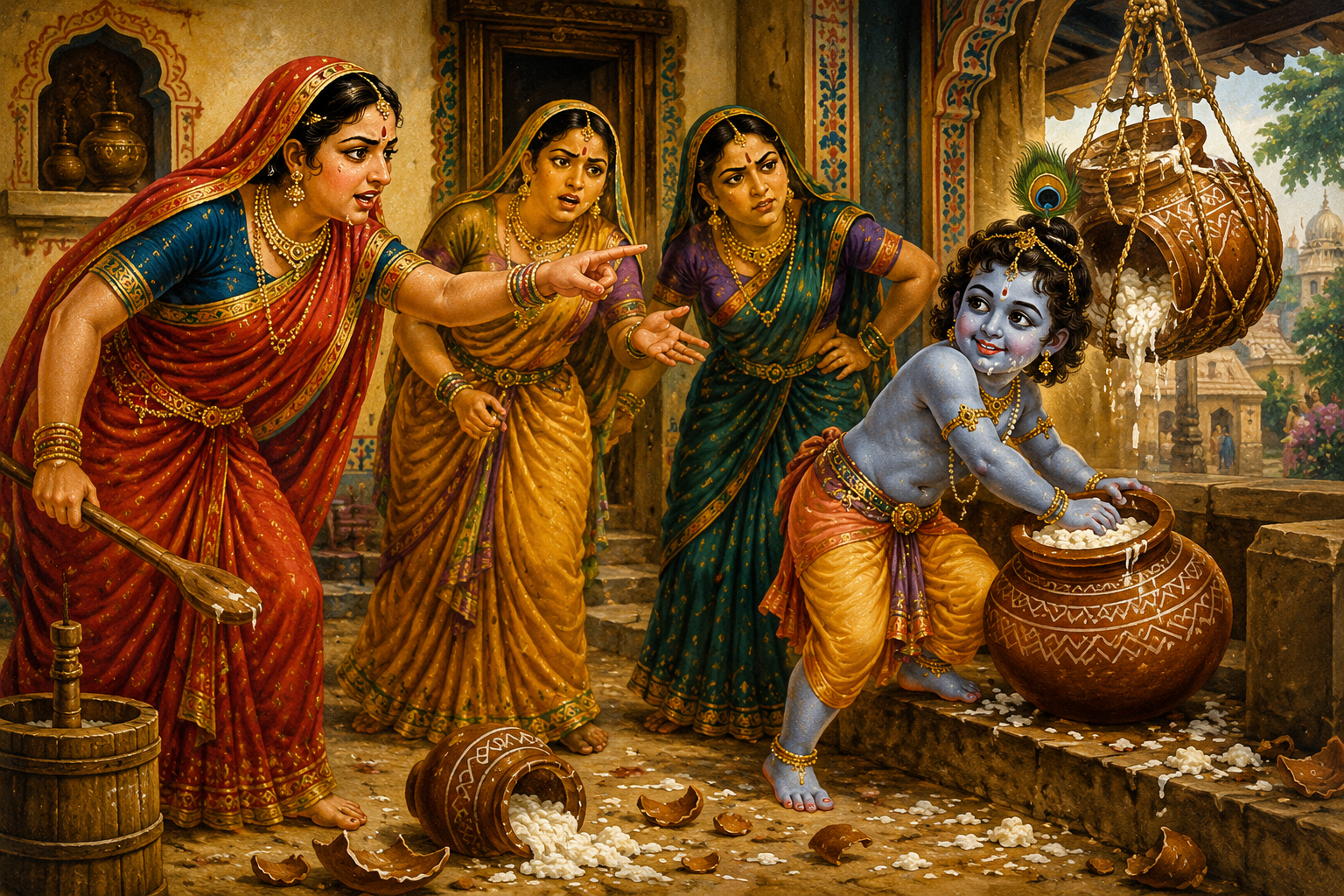
We don’t have to renounce our life, our children, or our materialistic possessions. We just have to renounce this very image that we have built for ourselves. Then, there will be pleasantness in our lives. When we are pleasant, we will act with clarity or with sattva guna. When we act with clarity, we make life pleasant for people around us as well. This very same fact is depicted in the small act of Krishna stealing butter.
The Yadav community of Vrindavan was a cowherd community. The men grazed the cows and collected the milk, while the women churned it, made butter, and stored it. They would then sell this for their livelihood.
Our identification with something is stronger especially when our association with it is either for a long time or of higher intensity of feelings. A job is one area where both of these could happen, either because we have been working for a larger part of life or we are also doing it with passion. So, if anything were to happen to this part of our life, it would severely affect us because we have strongly identified with it.
It was the same with the Gopis, the wives of the cowherds who spent all day churning the milk.
It is very natural to understand. Say you prepare malai kofta for three straight hours and the serving bowl just slips from your hand. It will cause you a lot of unpleasantness, right? That is because, since you have put in a lot of time and effort, you tend to identify with it.
With identification comes attachment, and with attachment comes control. If there is something that goes against the flow of life, it is control. We cannot always decide what happens to us, but we always have the free will to respond to whatever happens to us. But what if we didn’t have this attachment that comes from the false image? We would be able to experience every moment of life to the fullest, right?
That is exactly what Krishna wants, for us to live fully, freely, and happily. So, Krishna comes to take away the very cause of this unpleasantness, that too lovingly. He beautifully portrays this when He says the following in the Bhagavad Gita, chapter 2, verse 47
“Karmaṇy-evādhikāras te mā phaleṣhu kadāchana, mā karma-phala-hetur bhūr mā te saṅgo ’stvakarmaṇi”
Translation: You have a right to perform your prescribed duties, but you are not entitled to the fruits of your actions. Never consider yourself to be the cause of the results of your activities, nor be attached to inaction.
📖 Bhagavad Gita 2.47 — Read in Bhagavad Gita ↗
Initially, this might seem very difficult to accept. Why should I give up attachment to the results of my actions?
This is again because we love our false image so much. We develop attachment, and with attachment comes control, which stops us from living fully. Now, how do we give up this false image if we love it so much? How about loving something even more, to the point that this false image becomes irrelevant? This “giving up” of the false image is the “surrender” that Krishna talks about in the following verse in the Gita:
“tam eva śharaṇaṁ gachchha sarva-bhāvena bhārata, tat-prasādāt parāṁ śhāntiṁ sthānaṁ prāpsyasi śhāśhvatam”
Translation: Surrender exclusively unto Him with your whole being, O Bharat. By His grace, you will attain perfect peace and the eternal abode.
📖 Bhagavad Gita 18.62 — Read in Bhagavad Gita ↗
The Gopis show us the beautiful expression of surrender, one born naturally from overwhelming love for Krishna.
They loved Krishna so much that their own false self became irrelevant. They would have spent hours churning the butter, but they cried with happiness when He broke their butter pots and stole their hard work. What madness must it take to love so deeply?
They were not scholars. They were not royals. They didn’t know the ways of the world. They were simple village housewives who showed that surrender can be beautiful and sweet too, by loving Krishna more deeply than their own false self. They showed what Bhakti is!
Bhakti may appear simple, but it has profound depths and is filled with rasa. Such is the power of Bhakti that the devotee’s love can even bind the Supreme Lord Himself.
Shree Krishna says in the Bhagavad Gita:
“yoginām api sarveṣāṁ mad-gatenāntar-ātmanā śraddhāvān bhajate yo māṁ sa me yuktatamo mataḥ”
Translation: Of all yogis, those whose minds are always absorbed in Me, and who engage in devotion to Me with great faith, them I consider to be the highest of all.
📖 Bhagavad Gita 6.47 — Read in Bhagavad Gita ↗
At the end of the sixth chapter (Dhyana Yoga), Arjuna asks about the path of meditation. Krishna concludes by explaining that while meditation, knowledge, and action are vital, the practitioner grounded in loving devotion (Bhakti) surpasses them all.
Now, a question may arise. What's the best way to develop Bhakti?
A good place to start is to get satsang. “Sat” means the eternal or the Paramatma and “Sang” means company. So, it refers to the company of devotees. This is the easiest path to enter and progress in Bhakti. This is reiterated again and again in multiple scriptures.
From Śrīmad-Bhāgavatam (11.3.30):
“bhavanti hṛt-karṇa-rasāyanāḥ kathāḥ taj-joṣaṇād āsv-apadv-aṁśato bhakty-anud-hṛtīr bhaktir anukramiṣyati”
Meaning: The messages of My activities are a source of pleasure to the ear and the heart. When one associates with devotees, these topics flow like nectar. By hearing these topics, one gradually progresses on the path of liberation, and then pure devotion and attachment to Me are fixed.
📖 Śrīmad-Bhāgavatam 11.3.30
Now, you might be thinking, where can I get an association of devotees?
The fact that you are reading this can itself be seen as an invitation to join the vibrant community at the Radha Krishna Temple of North Carolina. There is so much content competing for our attention. Yet, here you are, spending some time reading about Shree Krishna and His divine leelas.
And what better occasion to turn our hearts toward Shri Krishna than Janmashtami? We warmly invite you to join the Grand Three-Day Janmashtami Festival at the Radha Krishna Temple of North Carolina and immerse yourself in the joy, devotion, and sweetness of His divine leelas.