All of us want to be happy. We try to find this happiness in the ways we know, it might be in career by being ambitious to get admission into a university or to get into a dream company, or by seeking security from material wealth, or by enjoying the taste of good food, or by seeking validation from the people around us. But, peace remains elusive because our mind constantly keeps shifting goalposts. Achieving a goal, or earning a lump sum of money, or having great food can give the temporary high but if we notice closely, it becomes the baseline after a few days. To experience a similar kind of thrill, we chase yet another goal.
To find peace and happiness, the only way is to detach our senses from material chaos and anchor them in something permanent. That permanent anchor is God, the ultimate source of everlasting and infinite bliss that our soul naturally longs for. We want to anchor our minds in Him, but for us materially conditioned souls, it is extremely difficult to attach the mind to the formless aspect of God. There is a deeply felt need for a concrete form, name, and stories to cultivate focus and anchor our devotion.
In Bhagavad Gita (Verse 4.8), Shree Krishna outlines His divine descension:
"paritrāṇāya sādhūnāṁ vināśhāya cha duṣhkṛitām
dharma-sansthāpanārthāya sambhavāmi yuge yuge"Translation: To protect the righteous, to annihilate the wicked, and to reestablish the principles of dharma, I appear on this earth, age after age.
📖 Bhagavad Gita 4.8 — Read in Bhagavad Gita ↗
When we look closely at these three stated reasons, something fascinating happens:
To protect the righteous:
Does God really need to manifest on Earth to protect his devotees? Let us look at the following instances:
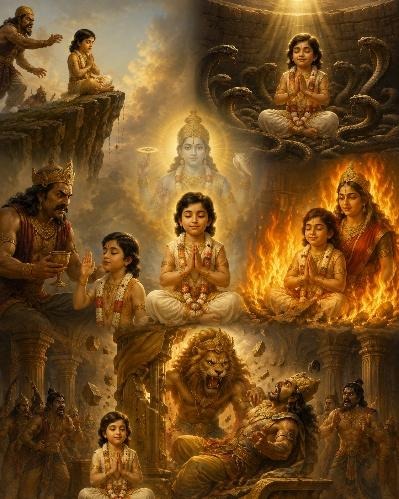
Prahlad Maharaj: Consider the young prince Prahlad, whose own father, the tyrant king Hiranyakashipu, tried relentlessly to end his life. Prahlad was hurled from steep cliffs, cast into dark pits swarming with venomous serpents, fed deadly poison, and forced into a roaring inferno alongside Holika. Yet, Lord Vishnu did not stand physically beside Prahlad to shield him from any of these cruelties. Prahlad simply closed his eyes, completely absorbing his consciousness in God within his heart. That total surrender was all that was needed. Through the pure power of his devotion, the lethal poison lost its potency, the raging fire turned soothingly cool, and the serpents refused to strike.
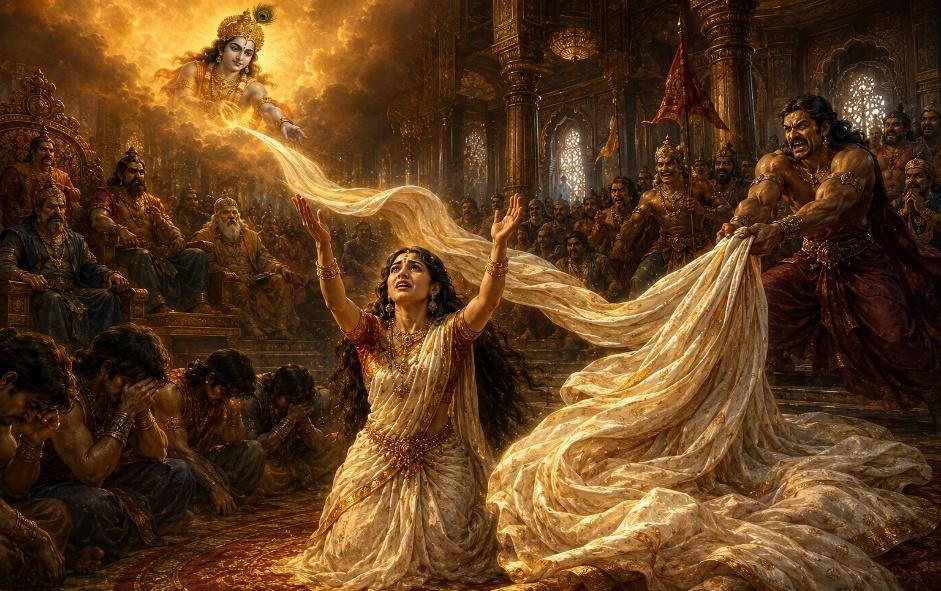
Draupadi: Consider Draupadi during her darkest hour in the royal court of the Kauravas. As Dushasana began to disrobe her, Shree Krishna was miles away in Dwarka. In her initial anguish, Draupadi tried to hold onto her sari with her own strength, and then turned her desperate eyes toward her mighty husbands only to see them bow their heads in helpless silence. When human strength and worldly protectors failed her completely, she let go of all self-reliance. Raising both hands toward the heavens, she called out to Shree Krishna from the quietest depths of her soul. In that instant, without stepping into the assembly or lifting a weapon, Shree Krishna responded from afar. An endless, unfurling stream of cloth appeared out of nowhere, shielding her honor across space the very moment her surrender became complete.
To annihilate the wicked:
The scriptures state that God creates, maintains, and dissolves millions of universes simply by willing it. When cosmic dissolution happens, God doesn't pick up weapons or wage wars. He simply wills it, and entire galaxies disappear. If He can dissolve the entire cosmos with a single thought, If He can withdraw the entire universe in a single instant, why would He need to descend in an Avatara, armed with a bow or a mace, simply to deal with one demon?
To establish dharma:
The laws of dharma are already eternally recorded in the Vedas. To revive them, God doesn't need to descend. He simply empowers a pure saint.
So why did He truly descend? In his commentary, the Holy Bhagavad Gita, the Song of God, Swami Mukundananda illuminates this verse from a deeper perspective, revealing the profound intent behind each of the three points:
To establish dharma:
The highest dharma in human life than realizing God, dissolving our pride and ego, surrendering completely, and living with universal compassion? All of these divine qualities naturally awaken through bhakti (devotion). But to practice devotion, the mind requires steady focus, and focus requires a tangible anchor. By descending into the world, Lord Krishna provides us with His sacred names (nām), captivating forms (rūp), divine virtues (guṇ), and holy abodes (dhām). Through these accessible divine tools, conditioned souls can easily engage their minds, purify their hearts, and practice the supreme dharma of love and surrender.
To kill the wicked:
God slays demons not out of hatred, but to facilitate His divine pastimes (leelas) and reinforce the timeless truth that good ultimately triumphs over evil. These stories make the divine relatable, empowering us to choose righteousness over wrongdoing no matter how difficult our circumstances. Moreover, many of these "demons" were actually liberated celestial associates—like Jaya and Vijaya descending as Ravana and Kumbhakarna—who enacted these roles to support God's play. Because they were divine personalities, only God could slay them, liberating them back to His abode while giving humanity powerful, inspiring narratives that teach us to stand by the right path and help others.
To protect the righteous:
Here, "protecting the righteous" means nurturing the faith, love, and longing in the hearts of devotees. When Lord Krishna descended, He blessed elevated souls with His physical presence, giving them the rare opportunity to meet Him face-to-face and turn fully toward Him. God's descension allowed qualified souls, such as the gopīs who assisted in His divine pastimes, to experience His love firsthand, fulfilling their deep spiritual longing and anchoring their hearts in devotion. By entering their world, He upheld their faith, fulfilled their spiritual longing, and protected the pure spark of devotion within their hearts.
We materially bound souls are constantly searching for real bliss, but no matter what we acquire in this world, our inner longing remains unfulfilled. Material objects simply don't have the capacity to satisfy a divine soul. God, on the other hand, is all-powerful, all-pervading, and completely self-sufficient (ātmārāma), eternally soaked in the infinite bliss of His own being. He has absolutely no personal need to act, achieve, or descend into this world. So why would He take birth and perform so many human-like actions? He does it purely for us. Every single past-time, every step He took on earth, was an act of selfless grace aimed solely at lifting conditioned souls out of material suffering and drawing us back to Him.
Since the descension of Lord Krishna 5,000 years ago, billions of souls have made his divine leelas (past times) as the basis of their devotion, and purified their minds with ease and joy.
The Ramayan says:
rām eka tāpasa tiya tārī, nāma koṭi khala kumati sudhārī
In his descension period, Lord Ram helped only one Ahalya (Sage Gautam's wife, whom Lord Ram released from the body of stone). However, since then, by chanting the divine name "Ram," billions of fallen souls have elevated themselves.
The fifth original Jagadguru and Jagadgurutam, Shree Kripalu Ji Maharaj, beautifully summarizes this divine mystery:
hari harijan ke kārya ko, kāraṇ kachhu na lakhāya |
par upakār svabhāv vash, karat kārya jag āya ||
Whatever God and His saints do has no selfish motivation; out of their inherently merciful nature, they act solely for the grace and upliftment of others.
Hence, as Janmashtami approaches let us rejoice in the divine tools He left and lose ourselves in the sweet refuge of His names and past times and His grace.
This Janmashtami, come celebrate Shree Krishna's divine appearance at the Radha Krishna Temple of North Carolina and relish the devotional atmosphere of Braj recreated within the temple. With kirtans, darshan, Krishna Janam celebrations, Dahi Handi, cultural offerings, and other festive experiences, the temple comes alive with the names, forms, and leelas of Shree Krishna. Come with your family and friends and spend the occasion immersed in the joy and devotion of Janmashtami.