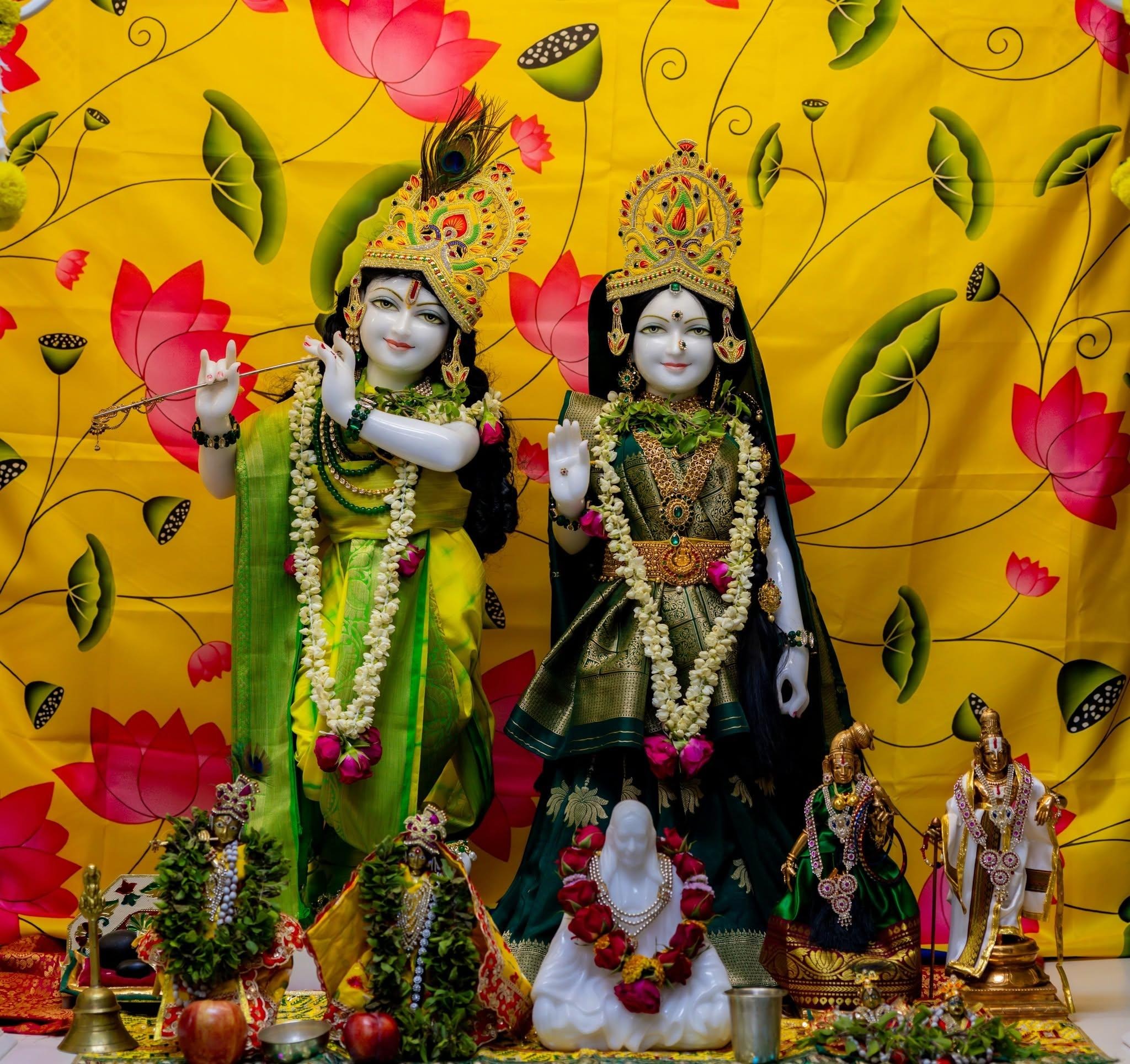
Every year during the auspicious month of Kartik, devotees across India—especially in the northern regions—celebrate Tulsi Vivah, the ceremonial wedding of the sacred Tulsi plant to Lord Shri Krishna in His form as the Shaligram. Observed with great devotion and joy, this festival marks the traditional beginning of the wedding season and carries a profound spiritual message about the nature of God, the subtlety of the ego, and the essence of selfless Bhakti (devotion).
The Oneness of the Supreme and the Purpose of Leela
The Vedas and Vedantic scriptures declare that the Supreme Reality is one, and nothing exists apart from Him. This foundational truth is affirmed throughout sacred literature:
“puruṣha evedaṁ sarvaṁ yad bhūtaṁ yach cha bhavyam”
Translation: The Supreme Being (Purusha) alone is all this—whatever has been and whatever is yet to be.
📖 Source: Rigveda 10.90.2 (Purusha Sukta)
“ekam evādvitīyam”
Translation: One only, without a second.
📖 Source: Chandogya Upanishad 6.2.1
“sarvaṁ samāpnoṣhi tato ’si sarvaḥ”
Translation: You pervade all, and therefore You are all.
📖 Bhagavad Gita 11.40 — Read in Bhagavad Gita ↗
If the Supreme Lord is one without a second and pervades the entire universe, a natural question arises: why did the One manifest as the many? The Taittiriya Upanishad (2.6.1) reveals that the Supreme willed, “bahu syāṁ prajāyeya”—“May I become many; may I bring forth creation.” In the Brahma Sutras (2.1.33), this manifestation is described as Leela (“lokavat tu līlā kaivalyam”)—the spontaneous, joyful divine play of the Lord, undertaken not out of any lack, but out of the sheer abundance of divine love.
The sense of separation from the Divine arises solely from ahankār (the ego)—the feeling of individual doership that claims, “I did this,” or “I achieved that.” Bhakti is the sacred path of dissolving this ego through love and surrender. Yet, as spiritual seekers progress, even devotion itself can subtly become a source of pride unless purified by the Lord’s grace. This spiritual truth is beautifully illuminated through the Puranic account of Vrinda and Lord Vishnu.
The Sacred Puranic Account of Vrinda and the Shaligram
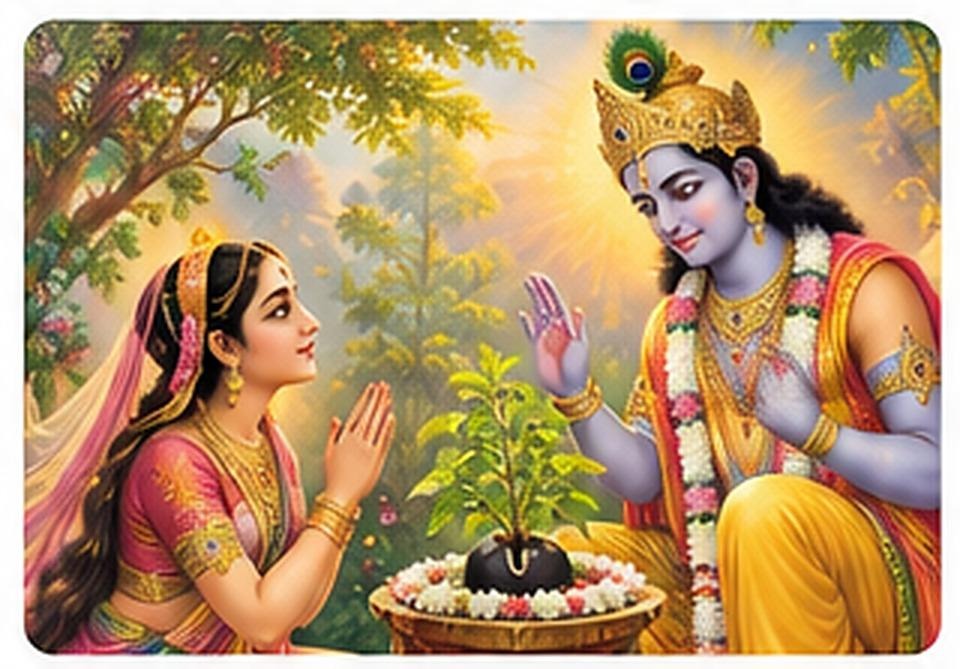
A devotional depiction of Vrinda in reverence before the Lord, with the sacred Shaligram and Tulsi.
According to the Padma Purana and Shiva Purana (with related accounts of her divine origin in Goloka found in the Devi Bhagavata Purana), Vrinda was a woman of extraordinary purity and devotion who was married to the powerful asura (demon) Jalandhara. By the spiritual strength of Vrinda’s steadfast chastity and devotion, Jalandhara became invincible and began troubling the Devatas (celestial beings), disturbing cosmic harmony.
Unable to overcome him, the Devatas prayed to Lord Vishnu for protection. To restore dharma and peace, Lord Vishnu intervened through His divine maya, appearing before Vrinda in the guise of Jalandhara. Once Vrinda’s vow of chastity was broken, Jalandhara lost his invincibility and was defeated in battle.
When Vrinda realized what had transpired, she was deeply moved by both grief and awe—grieved at the deception, yet recognizing that she had been drawn into the Lord’s own Leela. In her anguish, she pronounced a curse that Lord Vishnu would take the form of a stone, which manifested as the sacred Shaligram found along the Kali Gandaki River in Nepal. At the same time, she surrendered to the Lord, praying for liberation from her mortal form.
Moved by her unwavering purity, Lord Vishnu blessed her to manifest on earth as the sacred Tulsi plant. He declared that He would forever abide alongside her in the form of the Shaligram and that no offering or worship of the Lord would ever be complete without a Tulsi leaf. Thus, Tulsi Devi is revered across the Vaishnava tradition as Bhakti Devi—the embodiment and bestower of pure devotion.
Contemplating the Deeper Meaning of the Leela
Within traditional spiritual contemplation, this sacred narrative offers timeless guidance for seekers on the path of devotion:
- The Subtlety of Spiritual Ego: As a devotee advances in Bhakti, worldly attachments naturally loosen their grip, paling in comparison to the joy of divine love. However, a subtle ego can quietly emerge—the pride of spiritual progress, or the belief that one’s sādhanā (spiritual practice) and sevā (selfless service) are personal accomplishments.
- The Loss of Inner Peace: When devotion becomes tied to a sense of personal ownership, inner peace is disturbed by the fear of losing one’s attainment or by comparison with others. In the Bhagavad Gita (3.27 ↗), Lord Krishna cautions that the mind deluded by ego claims, “I am the doer,” forgetting that all strength and grace flow from the Divine.
The Lord’s Compassionate Intervention
Just as Lord Vishnu intervened to protect the Devatas and purify Vrinda’s devotion, the Lord compassionately dissolves the spiritual ego of His devotees so that their Bhakti may become entirely pure, humble, and free from attachment. Throughout Indian spiritual history, the lives of great saints vividly illustrate how the Divine gently removes even the subtlest traces of spiritual pride. One well-known incident comes from the life of Adi Shankaracharya.
Adi Shankaracharya and the Chandala
Walking through Kashi after bathing in the Ganga, the brilliant young ascetic Adi Shankaracharya (8th century, Advaita Vedanta) possessed immense scriptural and spiritual attainment, yet still carried a subtle trace of caste-based ritual pride. When a Chandala (an outcast) accompanied by four dogs crossed his path, Shankara asked him to step aside so his ritual purity would not be compromised. The Chandala responded with a piercing Advaitic inquiry:
“Are you asking this body made of food to move away from your body made of food, or are you asking the one all-pervading Consciousness to move away from Consciousness?”
Instantly recognizing Lord Shiva Himself in the guise of the outcast—with the four Vedas as the dogs—Shankara fell at His feet and spontaneously composed the Manisha Panchakam. In these verses, he affirmed that one who has realized the same divine Consciousness in all beings is worthy of reverence as a Guru, irrespective of birth.
The Selflessness of Tulsi and the Surrender of Doership
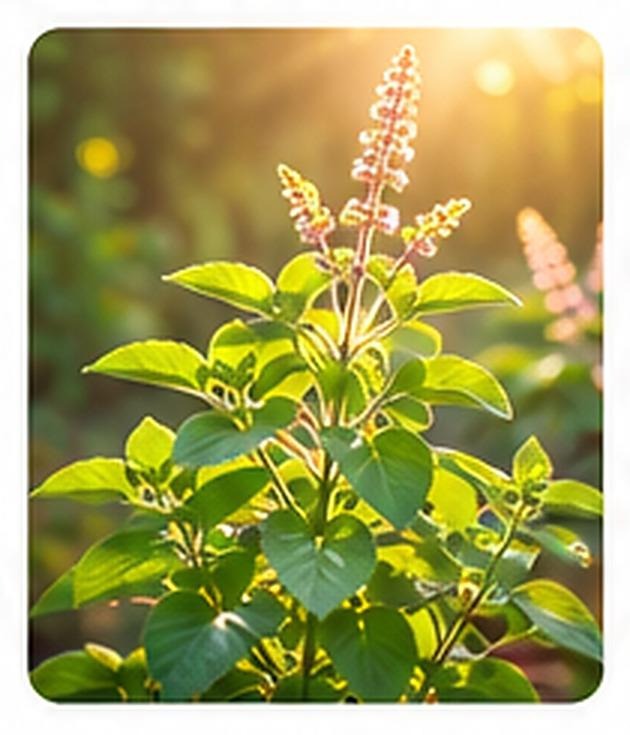
The sacred Tulsi plant, revered in the Vaishnava tradition as an embodiment of devotion.
The sacred form of the Tulsi plant itself embodies the highest ideal of egoless devotion. Plants and trees offer nourishment, shade, and life-giving oxygen without expectation, grievance, or a sense of separate individuality. In the Vaishnava tradition, Sri Chaitanya Mahaprabhu highlights this very quality of a tree as the mark of a true devotee:
“tṛiṇād api sunīchena taror api sahiṣhṇunā
amāninā mānadena kīrtanīyaḥ sadā hariḥ”Translation: One who is humbler than a blade of grass, more tolerant than a tree, devoid of all sense of false prestige, and ready to offer all respect to others can chant the holy name of the Lord constantly.
📖 Source: Sri Chaitanya Mahaprabhu, Shikshashtakam, Verse 3
True peace arises when a devotee relinquishes not only worldly pride, but also the ownership of their devotion. Sincere effort in sadhana remains essential, yet the inner attitude shifts from “I have attained” to “By the Lord’s grace, He has drawn this soul closer.”
Such humble, egoless Bhakti is so powerful that it melts even the hardest stone—symbolized eternally by the union of the Shaligram and the Tulsi leaf. In the Bhagavad Gita (9.26 ↗), Lord Krishna affirms that He lovingly accepts even a simple leaf (patram) offered with pure devotion.
This supreme stature of selfless devotion is most memorably revealed in the beloved Tulabharam leela of Vaishnava tradition. When Satyabhama attempted to weigh Lord Krishna against mountains of gold and priceless jewels, the scale would not budge—for wealth and offerings tethered to a sense of ownership or pride can never measure the Infinite. It was only when Devi Rukmini placed a single Tulsi leaf upon the scale with pure, surrendered love that the balance immediately tipped. Through this Leela, Lord Krishna placed Tulsi on the very highest pedestal, above all worldly treasures and personal merits, demonstrating that He is won over solely by selfless Bhakti that has completely renounced the sense of doership.
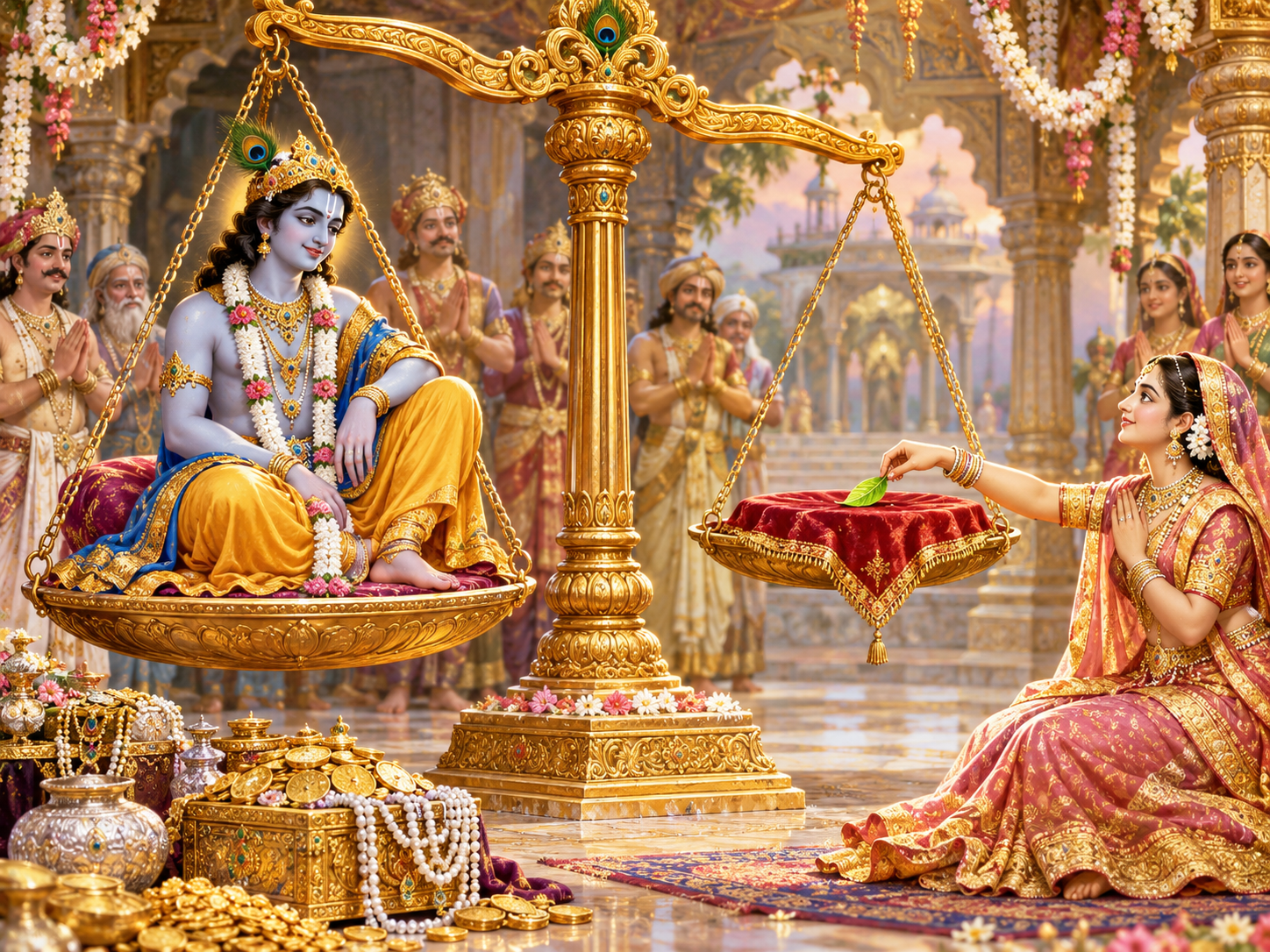
Devi Rukmini offers a single Tulsi leaf in the Tulabharam leela.
Living the Spirit of Tulsi Vivah
From wearing Tulsi kanthi mala (sacred prayer beads) to offering fresh Tulsi leaves in daily puja, Vaishnava worship continually reminds devotees of this sacred union. A seeker who cultivates such humble, surrendered devotion carries the Lord eternally in the heart, while the Lord gently carries the devotee across the ocean of samsara (worldly existence) to His divine abode.
Whenever one participates in bhajans, receives the blessings of saints, or visits the temple, Tulsi Vivah serves as a gentle reminder to bow in gratitude—recognizing that every moment of devotion is nothing other than the Lord’s own grace.
Celebrate Tulsi Vivah at Radha Krishna Temple of North Carolina
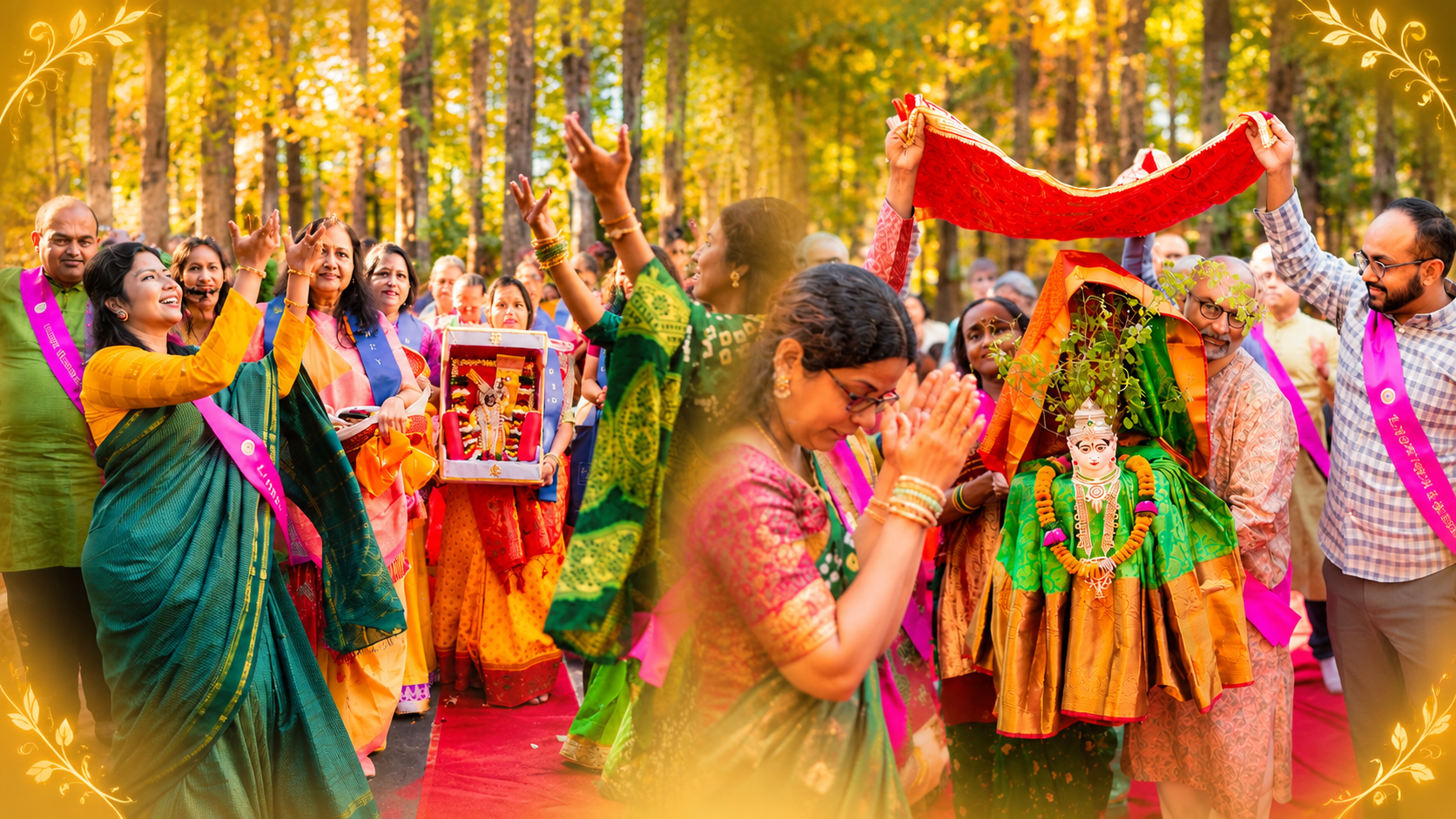
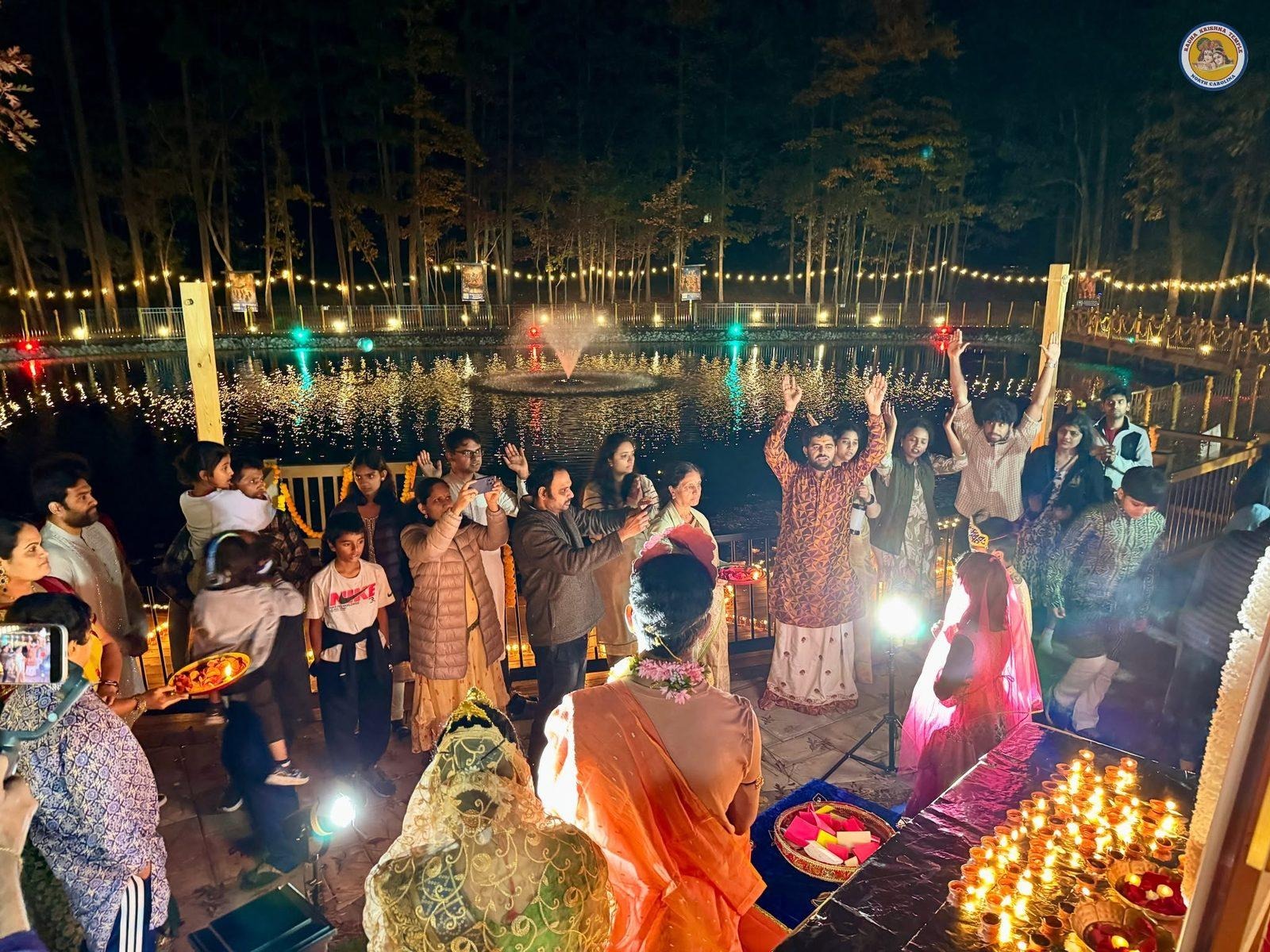
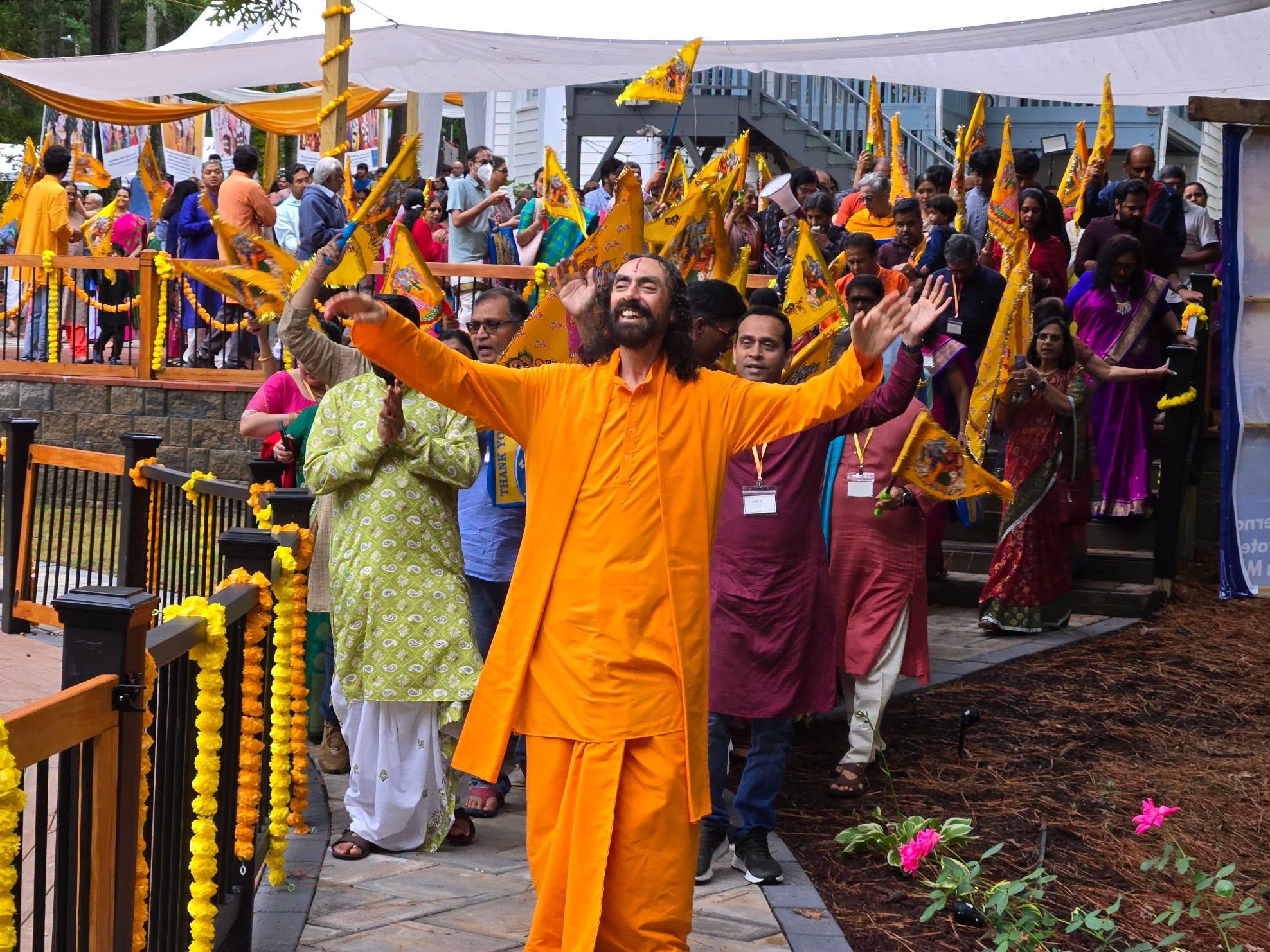
A joyful Tulsi Vivah celebration at RKTNC.
Devotees, families, and community members are warmly invited to experience this sacred union in person at the Tulsi Vivah celebration hosted by the Radha Krishna Temple of North Carolina (RKTNC) on Sunday, November 29, 2026, from 10:30 AM to 12:30 PM, at 23 Radhika Way, Apex, NC 27523.
Come together as baratis to take part in the auspicious wedding rites—including Tulsi Ji Aagman, Mangalashtaka Paath, Kanyadaan, Hasta Melap, Mangal Phere, and Maha Aarti, followed by prasad from the wedding feast. For full event timings, registration, seva opportunities, and daawat sign-ups, please visit the official event page at rktnc.org/tulasivivah2026.
You can also view highlights from last year’s temple festivities in Tulasi Vivah 2025 at RKTNC ↗, which captures the devotional atmosphere and traditional wedding rites celebrated by the Radha Krishna Temple of North Carolina community.